What changed on 7 October
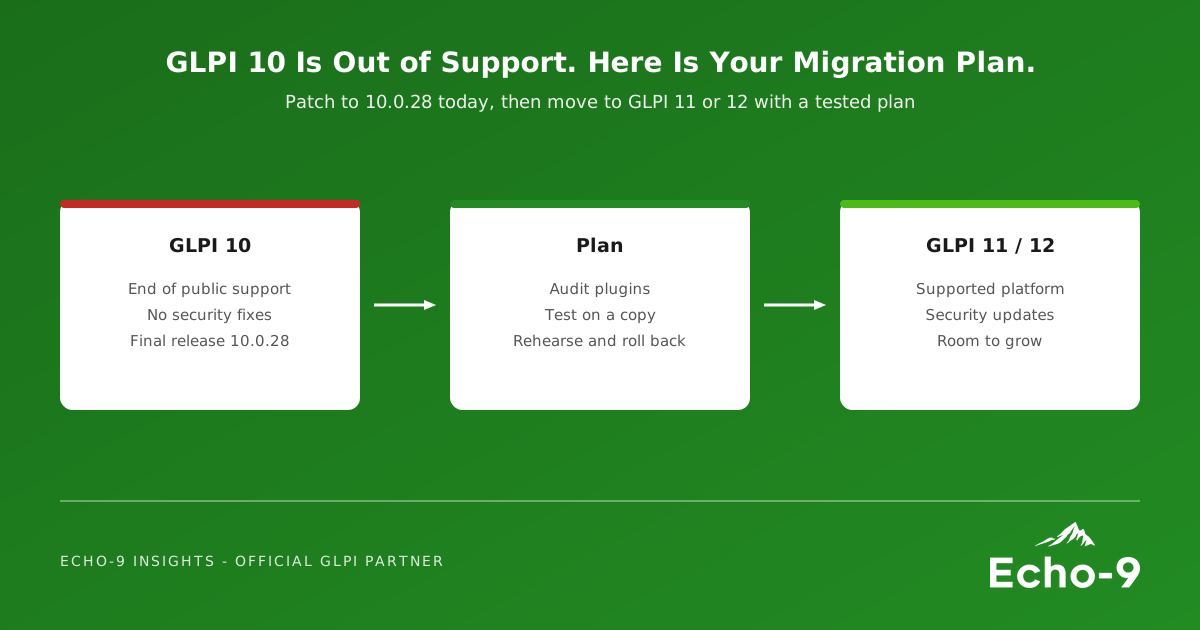
Teclib's support model always covers the two latest major versions of GLPI. When GLPI 12 was released on 7 October 2026, GLPI 10 dropped out of that window. Teclib's end of support notice is explicit: instances still running GLPI 10 no longer receive bug fixes, security updates, or assistance under a GLPI Network subscription. The only exception is customers who have taken GLPI Network Extended Support.
GLPI 10.0.28, released on 30 September, is the final release of the 10.0 branch. It fixed several high-severity issues, including an authorisation bypass in massive actions, privilege escalation through user cloning and an SQL injection in the form actors dropdown. Anything found after that will not be fixed on GLPI 10.
Why this matters more than it sounds
A GLPI server holds a great deal of sensitive information: users, devices, software, contracts, and often years of ticket history containing personal data. As Teclib puts it, running an unsupported version exposes your service desk to unpatched vulnerabilities and leaves your team without help when an issue arises.
For UK public sector bodies, schools and charities, that is also a governance question. If your organisation holds Cyber Essentials or reports against ISO 27001, it is worth asking your assessor or auditor how an unsupported service management platform sits in scope, before they ask you.
Credit where it is due
Spanish Platinum Partner TICGAL marked the date with a memorable post: "On October 7, there'll be a funeral. And a birth." Their accompanying article also explains the newer GLPI lifecycle: a new major release each October, with 18 months of bug fix and security support followed by six months of security-only patches. The current status of every version is published on the GLPI Network lifecycle page.
That faster rhythm means migration is no longer a once-a-decade event. It is part of running GLPI well.
A five-step plan
- Patch to 10.0.28 now. It is the last public release of the branch and the stable baseline for any upgrade path.
- Choose your target. GLPI 11 is the minimum to stay supported. GLPI 12 avoids a second migration later, provided your plugins are ready for it.
- Audit plugins and integrations. Every plugin must be compatible with the target version. GLPI Network plugins are ported by Teclib; community and in-house plugins need checking with their maintainers.
- Check the platform. GLPI 12 needs at least PHP 8.3 and MariaDB 10.11 or MySQL 8.0. Reverse proxies, internal webhooks and inventory authentication also need attention.
- Rehearse, then migrate. Upgrade a copy of production, test your most common processes, and go live in a planned maintenance window with a full backup and a tested rollback.
GLPI 11 or straight to GLPI 12?
For most organisations we speak to, GLPI 12 is the sensible destination: it is the newest supported version and gives you the longest runway. The deciding factor is usually plugins. If a business-critical plugin is not yet available for GLPI 12, moving to GLPI 11 first keeps you supported while you wait. If you genuinely cannot move this year, GLPI Network Extended Support exists as a temporary bridge, but it is a bridge, not a destination.
How Echo-9 helps
As an official GLPI partner, Echo-9 runs GLPI migrations for UK public sector, education, charity and mid-size organisations. A typical engagement starts with a pre-migration audit of your version, plugins, integrations, custom reports and infrastructure, then moves to a rehearsal on a copy of your data, a written cut-over plan and a supported go-live. Where an in-house plugin has no GLPI 12 version, we can port it.
Unsupported software does not fail loudly. It fails quietly, one unpatched vulnerability at a time.
Plan your GLPI migration
Tell us which GLPI version you run and which plugins you rely on, and we will come back with the points to check before you upgrade.