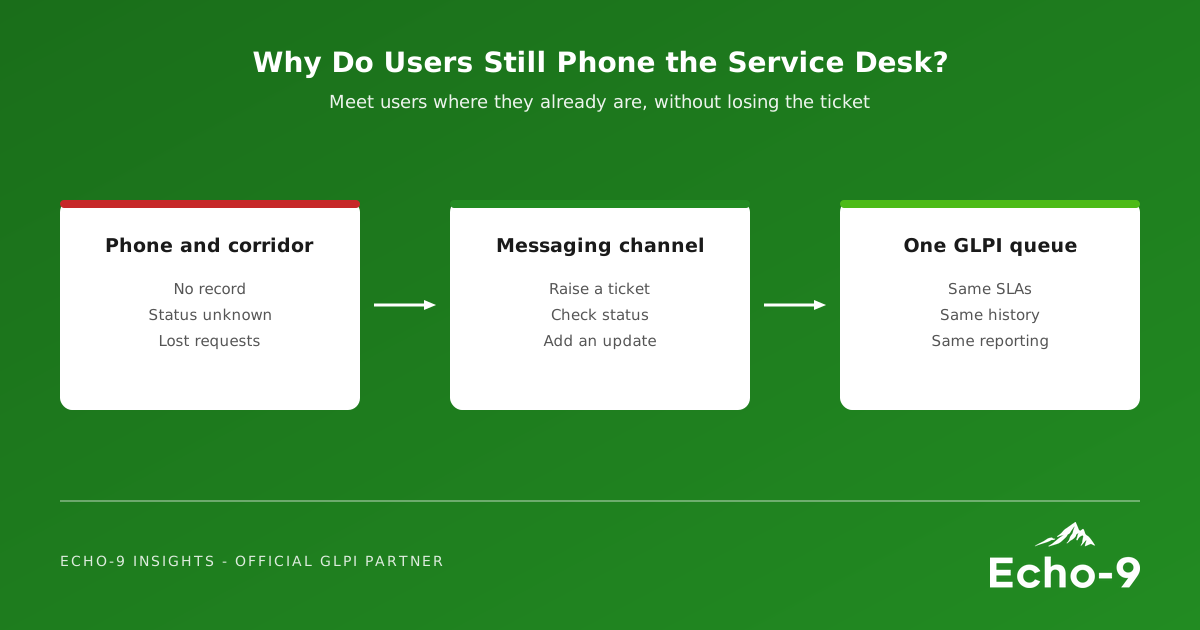
A good question from the front line
Brazilian service desk lead Daniel Augusto asked exactly this in a recent post. After years working with ITSM tools and studying ITIL, he wondered why so many users still prefer to phone support or go to the IT office in person. His conclusion: if WhatsApp is already part of people's daily lives, why not use it to make raising a ticket simpler?
He built a prototype chatbot connected to GLPI that lets users open tickets through WhatsApp, check the status of their requests, add updates to them and search the knowledge base. As he put it, technology should adapt to people, not the other way round.
The real problem is reach
Portals work well for people who sit at a desk, signed in all day. Many of the people UK service desks support do not: care and support workers, school site and catering staff, field teams, volunteers, people on shared devices. For them, a phone call or a word in the corridor is simply the quickest route.
The cost is that those requests often arrive without a record, without a category and without a way for the user to see progress. They are also the ones most likely to be forgotten.
What GLPI offers today
GLPI already accepts requests from more than one channel. Email collectors turn messages to a support address into tickets. The High-Level API lets other systems create and update tickets, which is the kind of integration a prototype like Daniel's relies on; GLPI 12 introduces version 3 of that API alongside previous versions.
Teclib also publishes an official WhatsApp plugin, which lets users open tickets from WhatsApp and follow them from the app or a web browser. According to the documentation, it requires a GLPI Network Basic subscription or higher (it is also available on GLPI Network Cloud), GLPI 11.0.3 or later, an active WhatsApp Business account with Meta, and a GLPI instance reachable over the internet via HTTPS.
Check before you switch it on
- Data protection. Teclib's documentation notes that the plugin stores the user's phone number in GLPI. Update your privacy notice and records of processing, and think about what users might send, such as photos containing personal data.
- Policy. Many organisations restrict WhatsApp for work. Agree which channels are approved, and for whom, before you promote them.
- Identity. Decide how a phone number is matched to a GLPI user, and what happens with unknown numbers.
- Exposure. A channel that needs GLPI on the internet changes your security posture. Plan the reverse proxy, hardening and patching that go with it.
- One queue. Whatever the channel, the ticket should land in the same queue, with the same categories, SLAs and reporting.
WhatsApp, Teams or something else?
For many organisations the right answer is not WhatsApp at all, but the messaging tool staff already use at work, such as Microsoft Teams, or a simple text message or QR code route for frontline staff. The principle is the same as Daniel's: go to where people already are, and make sure every request still becomes a ticket.
How Echo-9 helps
Echo-9 helps UK organisations design their service desk channel strategy around the people they support. We can configure the official WhatsApp plugin for GLPI Network customers, connect other channels through the API, and make sure every route lands in one well-run GLPI queue. Where a data protection impact assessment is needed, we provide the technical detail to support it.
If users keep choosing the phone, the phone is telling you something about your other channels.
Review your service desk channels
Tell us who you support and how they contact you today, and we will suggest the channels worth adding to GLPI.