The hidden cost of dispatch
Richard Loureiro of Brazilian GLPI specialist NexTool Solutions put it neatly in a recent post: a native rule that always sends a category to the same named technician works for months, until that person goes on holiday. Tickets keep arriving in their name, nobody picks them up, and the SLA fails quietly because the queue had an owner. As he says, having an owner is not the same as being attended to.
What a simulation shows
NexTool also simulated the same service desk week 50 times with different assignment methods: 200 fictional tickets and five technicians, each a specialist in one or two categories. Average wait before work started:
- Skills-based, with AI triage and overflow: 33 minutes
- Least load: 54 minutes
- Skills-based with AI triage: 66 minutes
- Free queue, checked every 30 minutes: 77 minutes
- Skills-based with human triage: 85 minutes
- Round-robin: 94 minutes
Round-robin and least load feel fair, but in the model only around one ticket in five reached someone who specialised in it, and the team worked about 190 hours to deliver what skills-based routing delivered in 128. Pure skills-based routing created bottlenecks: one specialist worked 43 hours in a week while another worked 12. The overflow rule fixed that: if the specialist could not start within an hour, the ticket went to whoever was free. It gave the best result in 46 of the 50 weeks.
NexTool is clear that this is a model for comparing methods, not a prediction of any real queue, and publishes the spreadsheet so teams can try their own numbers.
Doing it in GLPI
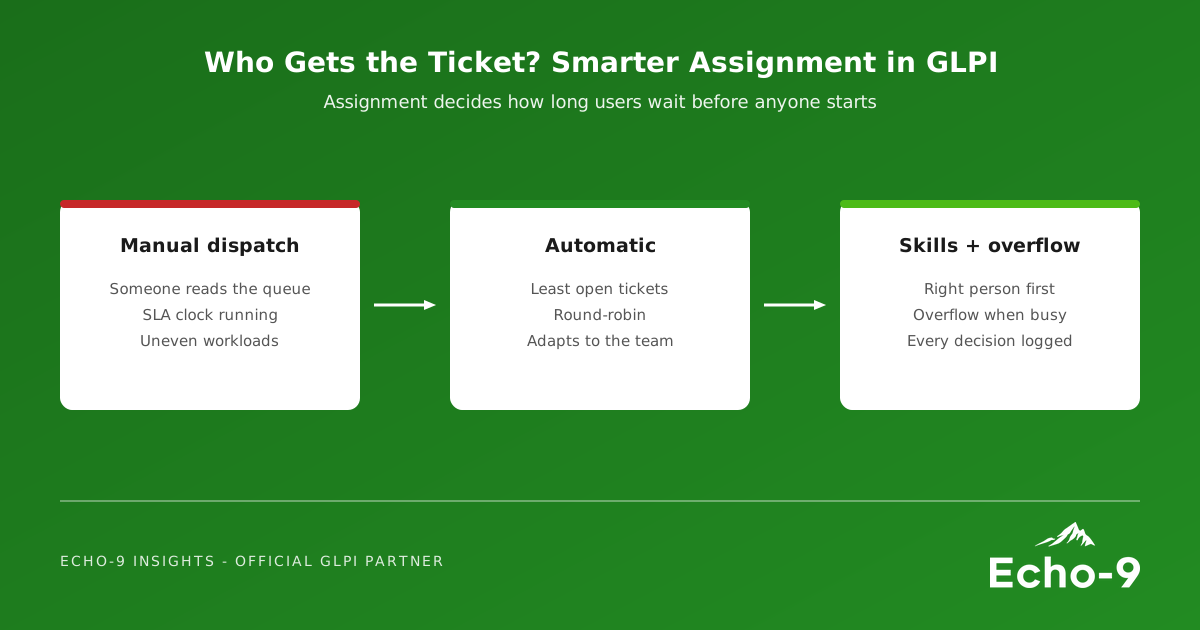
GLPI already gives you most of the building blocks. Each ticket category can have a responsible group and technician. Business rules can assign tickets by category, requester, location or other criteria. SLAs and OLAs support escalation levels that apply a rule before or after a deadline, which is how an overflow to a second group can be built natively.
What native rules do not do is balance work across a group. They point to a fixed destination. That is the gap NexTool's free Smart Assign module fills, and Richard reports it is used in more than 400 GLPI environments:
- Load balancing: the ticket goes to the group member with the fewest open tickets at that moment.
- Round-robin: one each, in order, when everyone has similar capacity.
- Self-adjusting: people joining or leaving the group are picked up automatically.
- Logged decisions: every assignment, or the reason a ticket was not assigned, is recorded, which answers why did this come to me?
NexTool lists compatibility with GLPI 10.x and 11.x and advises keeping native rules for sensitive exceptions, such as VIP requesters or critical systems. It also notes the gain is marginal for teams of one or two technicians.
A practical recipe
- Fix categories first. Assignment is only as good as the category a ticket arrives with.
- Map groups to skills. Each category gets a responsible group that can genuinely resolve it.
- Balance within the group rather than naming individuals.
- Add an overflow. Use OLA escalation so tickets nobody has started move on.
- Keep rules for exceptions and measure time to own every month.
How Echo-9 helps
Echo-9's service desk optimisation work with UK organisations often starts here. We review your categories, groups and rules, model the options against your own ticket data, and configure the result in GLPI, including any plugin, tested on a staging copy first.
The fastest fix is useless if the ticket sits unassigned for an hour.
Review your ticket assignment
Share how tickets are assigned today and we will suggest the changes that would shorten time to own the most.