The multi-site education IT challenge
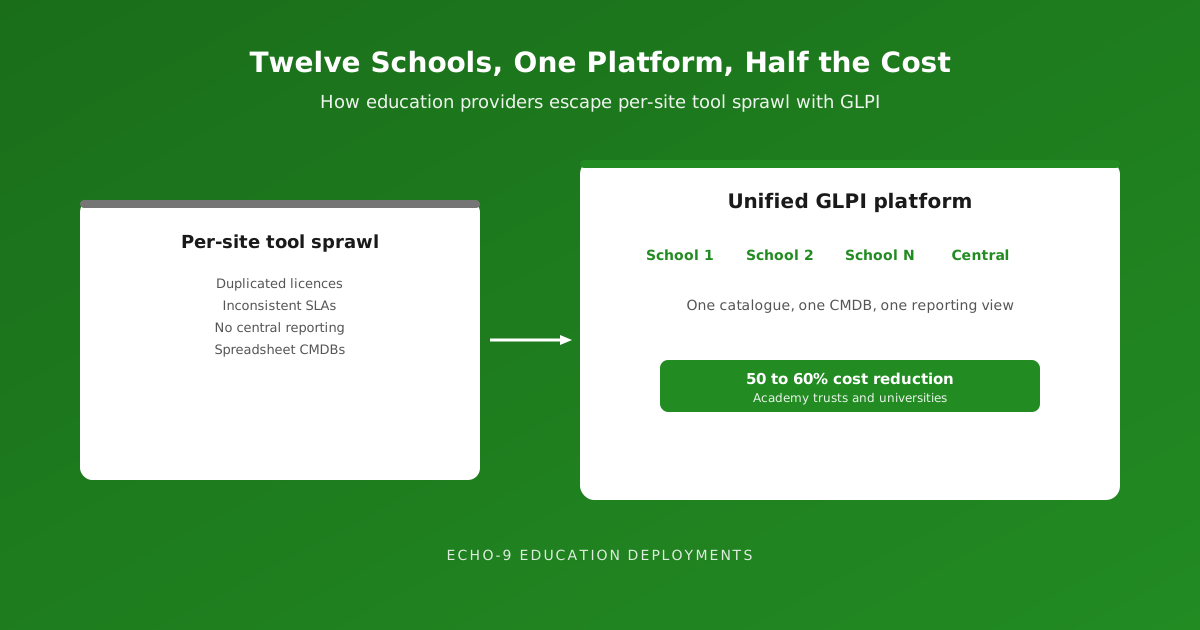
Education IT is inherently multi-site. An academy trust may run a dozen schools across a county. A university spans faculties, halls of residence, research labs and satellite campuses. Each site historically acquired its own tools — a helpdesk here, a monitoring product there, spreadsheets for asset tracking everywhere.
The result is inconsistent service levels, duplicated licence costs, no central reporting for trust or university leadership, and IT teams that spend more time reconciling data than improving services.
The cost of per-site proprietary tooling
Proprietary ITSM and monitoring licences typically scale per user, per agent or per site. For a 12-school trust, that can mean twelve helpdesk instances — or one enterprise platform priced as if each school were a separate organisation.
Echo-9's open-source subscriptions are transparent: monthly or annual plans for GLPI, Zabbix, Wazuh or the full stack, cloud-hosted or on-premise, without per-module surprise invoices. For budget holders in education — where every pound diverted from the classroom matters — predictable ITSM costs are transformative.
Unified GLPI: one catalogue, one CMDB, one view
GLPI's multi-entity model supports the education structure directly: separate schools or faculties as entities, shared services at trust or university level, central governance with local autonomy. One service catalogue published in business language. One CMDB spanning the estate. One reporting view for leadership.
Our academy trust case study — a multi-academy trust running 12 schools with 8,000 pupils — achieved 50% cost savings and eliminated per-school tool sprawl that made central reporting impossible.
Our university case study — a Russell Group institution with 35,000 students — replaced ServiceNow with the full Echo-9 stack and achieved 60% cost reduction with equivalent or improved capability.
Education-specific workflows
Beyond generic ITSM, education deployments commonly include:
- Classroom and lab asset tracking — devices assigned to rooms, labs and loan pools
- Loan device management — term-time checkout, return workflows and overdue tracking
- Term-time support patterns — scaled staffing and SLA adjustments for exam periods and holidays
- Facilities and AV — extending the CMDB to building systems, with OT visibility considerations covered in our NCSC OT article
Echo-9 plugins extend the platform: GilpAI for student and staff self-service, ServiceMap for visualising complex campus infrastructure, and Sovereign AI where student data sensitivity requires on-premises inference.
Compliance and data sovereignty
Education providers handle sensitive personal data — student records, safeguarding information, research data. Echo-9 deployments align with GDPR, WCAG 2.2 AA accessibility, Cyber Essentials and ISO 27001. Data processing agreements, export capabilities and audit trails are part of the platform.
For AI-assisted self-service, Sovereign AI keeps student and staff interactions on your infrastructure — relevant for trusts and universities evaluating portal chatbots without sending personal data to public cloud APIs.
The bottom line
Education does not need twelve helpdesks. It needs one platform that respects twelve contexts.
Open-source ITSM with Echo-9 delivers enterprise capability at education-appropriate cost — with proven results in academy trusts and universities across the UK.
Discuss your education deployment
Whether you are a MAT, a university or a college, we would welcome a conversation about your multi-site requirements.