The enterprise ITSM trap
ServiceNow set a standard. For many organisations — particularly in higher education, local government and the NHS — it became the default assumption: serious IT service management means ServiceNow, full stop.
The problem is not capability. ServiceNow is capable. The problem is cost structure, flexibility and dependency — especially for organisations that are not global banks with unlimited IT budgets.
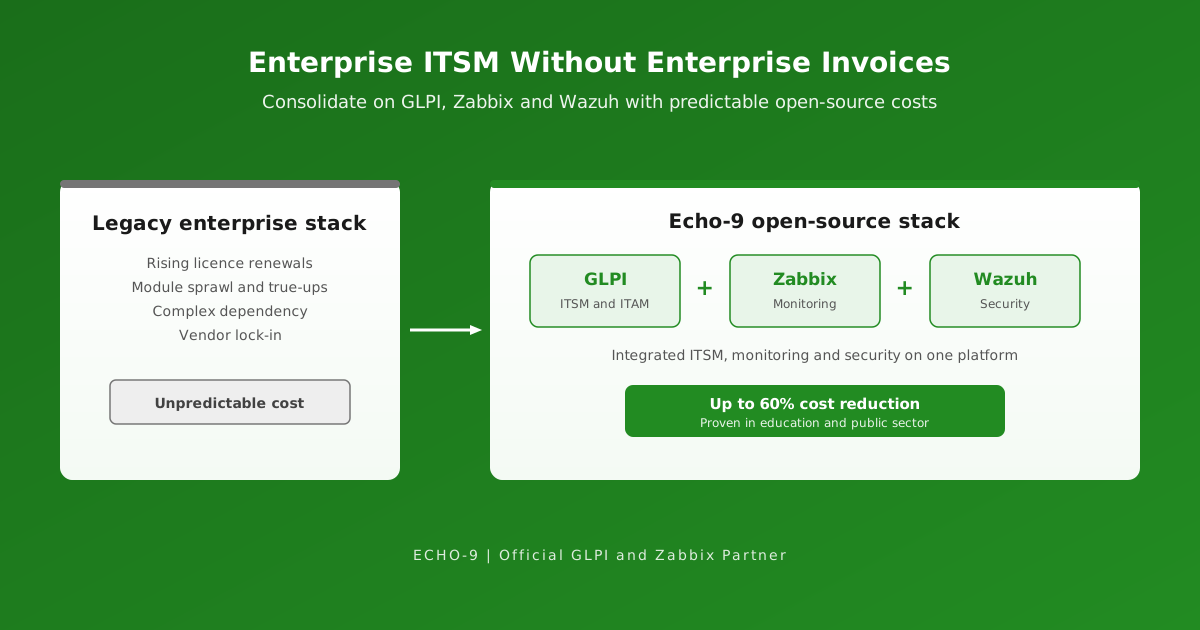
Annual licence renewals that grow faster than headcount. Module sprawl where each additional capability carries its own price tag. Implementation partners who charge enterprise rates for configuration that should be routine. A platform so complex that you need specialists just to maintain the specialists.
And underneath it all, a nagging question: are we paying enterprise prices for processes we could run more simply?
What organisations actually need from ITSM
Strip away the branding and most organisations need the same core capabilities:
- Incident management — log, prioritise, assign, resolve and report
- Problem management — find root causes, stop repeat incidents
- Change management — control risk, approve changes, maintain audit trails
- Asset management — know what you own, where it is, who uses it
- Service catalogue — publish services in business language, route requests correctly
- Self-service portal — let users help themselves for routine requests
- Reporting — measure what matters, report to leadership with confidence
ServiceNow delivers all of this. So does GLPI — an open-source ITSM and ITAM platform used by organisations worldwide, backed by an active community and a global partner network.
The difference is not what you can do. It is how much you pay, who owns the data, and how quickly you can adapt.
The open-source alternative is not a compromise
There is a persistent myth that open-source ITSM is for small teams with simple needs. Our experience — and our customers' results — say otherwise.
A large UK university replaced ServiceNow with the full Echo-9 integrated stack: GLPI for service management and asset tracking, Zabbix for infrastructure monitoring, Wazuh for security operations. Result: 60% cost reduction with equivalent — in some areas improved — capability. Read the case study.
A software company consolidated Jira Service Management and Datadog into the unified open-source platform. Result: 45% cost reduction and a single operational view instead of two disconnected products. Read the case study.
An academy trust running 12 schools unified under one centralised GLPI platform. Result: 50% cost savings and consistent service delivery across every site. Read the case study.
A small charity moved from spreadsheets and free-tier tools to a professional managed stack. Result: enterprise-grade capability at pricing that respects their mission. Read the case study.
These are not edge cases. They are organisations that asked a straightforward question: what are we actually paying for, and is there a better way?
What changes when you move
Cost becomes predictable
Open-source subscriptions through Echo-9 are transparent. Monthly or annual plans for GLPI, Zabbix, Wazuh or the full stack. Cloud-hosted or on-premise. No per-module surprise invoices. No licence true-ups that appear mid-year.
You own your data and your roadmap
GLPI is open source. Your data lives in your environment — cloud-hosted by Echo-9 or on-premise under your control. If you need a custom workflow, a bespoke plugin, or an integration that does not exist yet — Echo-9 builds it. We develop plugins such as GilpAI, ServiceMap, ProblemAI and Pwned specifically for production GLPI environments.
ITIL alignment without ITIL bureaucracy
GLPI supports full ITIL-aligned processes: incident, problem, change, release, configuration management and service catalogue. But it does not force heavyweight process on organisations that need pragmatism.
Compliance is built in, not bolted on
Echo-9 deployments align with GDPR, WCAG 2.2 AA accessibility, Cyber Essentials, ISO 27001 and NIST frameworks. Data processing agreements, export capabilities and audit trails are part of the platform — not premium add-ons.
What about migration?
The word "migration" makes budget holders nervous. It should not.
Echo-9's implementation methodology is ITIL-aligned and proven across education, public sector, charities and commercial organisations. We handle data migration from ServiceNow, Jira, legacy helpdesks and spreadsheets; process mapping; integration setup; and go-live support — we do not hand over and disappear.
Migration is also an opportunity. Most organisations we work with use the transition to rationalise processes they inherited — closing unused ticket categories, simplifying approval chains, rebuilding a CMDB that was never accurate in the old platform.
When ServiceNow still makes sense
We are not ideologues. ServiceNow remains the right choice for some organisations — particularly those with deep customisation, extensive non-IT workflows, or existing investments that make migration cost-prohibitive in the short term.
But if you are paying enterprise prices for standard ITSM processes, if your CMDB is a liability, if your teams maintain the platform more than they use it — it is worth asking whether the value matches the cost.
The bottom line
Enterprise-grade IT service management does not require an enterprise-grade invoice.
Open-source platforms have matured to the point where capability is no longer the differentiator — cost, flexibility, data sovereignty and speed of adaptation are. For organisations willing to look beyond the default choice, the savings are substantial and the capability is proven.
Discuss your options
Book a 20-minute conversation to explore whether an open-source stack is right for your organisation.