The incident treadmill
Every service desk leader recognises the pattern.
Ticket volume is high. The team is busy. Resolution times look acceptable. Leadership sees green dashboards.
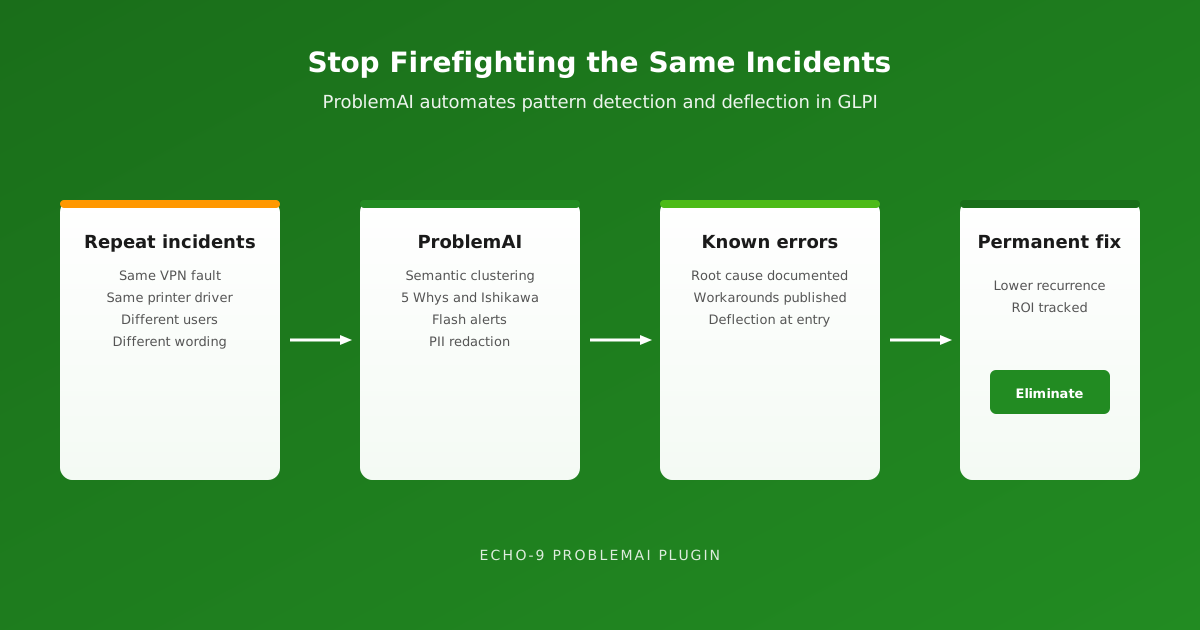
But ask a different question: how many of this month's incidents are repeats of the same root cause? The answer is usually uncomfortable. The same printer driver. The same VPN timeout. The same application crash after a Windows update. The same network switch flapping every Tuesday.
Each occurrence is a separate incident. Each gets resolved individually. Each closes with "user advised to restart" or "known issue — workaround applied." And each one will come back.
This is the incident treadmill — and problem management is supposed to be the exit ramp. In practice, it rarely is.
Why problem management fails in most organisations
ITIL defines problem management clearly: identify the root cause of recurring incidents, document known errors, and eliminate the underlying fault. The practice breaks down for predictable reasons.
- No time. Incident queues are full. Problem investigation is deferred because today's fires take priority.
- No tooling. Problem management lives in spreadsheets, email threads, or a GLPI problem module that nobody opens.
- No pattern recognition. Spotting that 40 incidents share the same root cause requires automation at scale.
- No deflection. Even when a known error exists, analysts creating new tickets do not see it.
The result: problem management becomes a quarterly slide in the ITSM review, not an operational practice.
What ProblemAI changes
ProblemAI is an Echo-9 plugin for GLPI that automates the parts of problem management that humans struggle to sustain — while keeping humans in control of decisions.
It is not a chatbot that summarises tickets. It is a problem management engine built into the GLPI workflow.
Semantic clustering
ProblemAI groups similar incidents using semantic analysis — not just keyword matching. When 15 users report "Outlook keeps crashing" and 8 report "email application closes unexpectedly," ProblemAI recognises these as the same problem.
Structured root cause analysis
When a problem is identified, ProblemAI supports structured RCA frameworks — 5 Whys, Ishikawa (fishbone) and Pareto analysis — not generic AI prose that nobody verified.
Incident deflection at the point of entry
As an analyst types a new ticket title, ProblemAI suggests related problems and known errors. If a documented workaround exists, the analyst can deflect the incident before it enters the queue.
Flash alerts for emerging patterns
When similar tickets spike — a sudden cluster of VPN failures, a burst of printing errors after a patch — ProblemAI raises a flash alert. This is early warning for outages and major incidents.
Privacy by design
PII is redacted before any model call. AI-generated content is labelled "drafted by AI" for EU AI Act transparency. For organisations running Sovereign AI, ProblemAI can use on-premises models so even redacted content never leaves the network.
Measuring the value
ProblemAI includes ROI tracking that connects problem management to business outcomes:
- Cost of problem — cumulative incident effort linked to an unresolved root cause
- Cost of fix — estimated effort to implement a permanent solution
- Deflection metrics — incidents prevented by known-error matching at entry
- Token budget controls — governance over AI usage costs
When you can show that a recurring VPN issue consumed 120 analyst hours over six months and a two-hour configuration change would eliminate it, the business case writes itself.
How this fits the wider ITSM practice
ProblemAI does not replace process. It makes process sustainable.
Echo-9's Incident, Major Incident and Problem Management Bootcamp helps organisations redesign their flows. ProblemAI provides the tooling that keeps those practices alive between bootcamps.
- Consulting establishes the process — roles, cadences, RCA standards, PIR framework
- ProblemAI automates pattern detection, deflection and structured analysis
- GLPI holds the problem records, known errors and linked incidents in one system of record
- Reporting shows recurrence rates, deflection rates and cost-of-problem trends to leadership
A realistic starting point
- Enable semantic clustering on existing incident data — see what patterns emerge from the last 90 days
- Turn on deflection prompts for analysts — surface known errors at ticket creation
- Configure flash alerts for high-volume categories — VPN, printing, email, authentication
- Run one structured RCA on the highest-cost cluster — prove the model with a single win
- Report the ROI — incident hours saved, deflections achieved, recurrence rate change
The bottom line
Closing incidents quickly is not the same as solving problems permanently.
ProblemAI does not replace your analysts. It gives them the pattern recognition, structured analysis and point-of-entry deflection that manual problem management cannot sustain at scale. Stop firefighting the same fires. Start eliminating them.
Request ProblemAI
ProblemAI is available as an add-on to Echo-9 GLPI subscriptions and implementations.