The AI rush meets the data sovereignty wall
Every ITSM vendor is adding AI. Ticket summarisation, suggested resolutions, chatbot deflection, automated categorisation — the capabilities are real and the productivity gains are genuine.
But behind most of these features is a simple architecture: your data goes to a public cloud API, a model processes it, and a response comes back. OpenAI, Azure OpenAI, Google Gemini — the provider varies, but the pattern is the same.
For many organisations, that architecture is fine. For others — NHS trusts, local government, defence contractors, legal firms, any organisation handling sensitive personal data or subject to strict data residency requirements — it is a non-starter.
The question is not whether AI can help your service desk. It can. The question is: can you use AI without sending your data somewhere you cannot control?
What Sovereign AI means at Echo-9
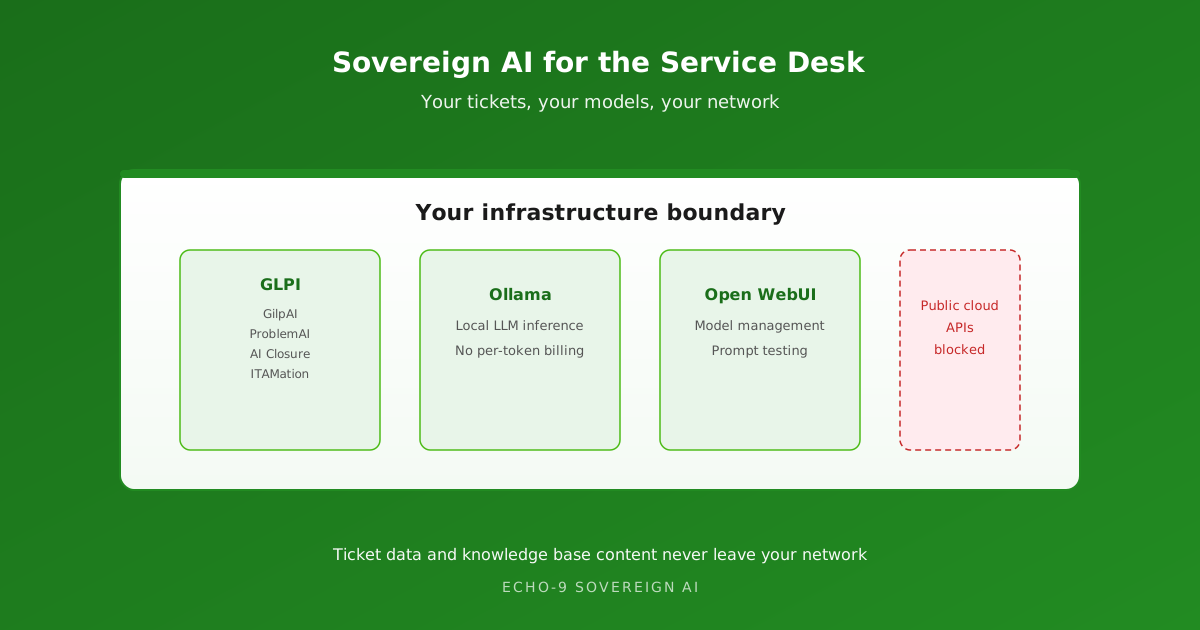
Sovereign AI is Echo-9's approach to running large language models entirely within your infrastructure — paired with GLPI and our AI plugins so ticket data, user information and knowledge base content never leaves your network.
The stack is built on proven open-source components:
- Ollama — runs open-weight language models locally on your hardware
- Open WebUI — provides a management interface for model selection, prompt testing and access control
- Echo-9 GLPI plugins — GilpAI, ProblemAI, AI Closure and ITAMation connect to the local model via your GLPI server, not via a public API
The model is reached from the server, not the end-user's PC. Inference happens on-premises. No per-token billing. No data egress. Optional air-gap for environments that require complete network isolation.
Which plugins use Sovereign AI?
GilpAI and LiveTalk
GilpAI is a self-service portal assistant that matches user requests to the right GLPI form, guides users through fields in chat, or hands off to a human via LiveTalk. Optional RAG grounds answers in your GLPI knowledge base. With Sovereign AI, user queries and knowledge base excerpts stay on your infrastructure.
ProblemAI
ProblemAI automates problem management: semantic clustering of recurring incidents, structured root cause analysis (5 Whys, Ishikawa, Pareto), and known-error deflection as analysts type new tickets. PII is redacted before any model call — and with Sovereign AI, even the redacted content stays local.
AI Closure and ITAMation
AI Closure and ITAMation provide structured close codes with optional AI assist for ticket resolution summaries. ITAMation proposes asset updates on ticket closure — with propose-then-approve workflows so humans stay in control.
Why this matters beyond compliance
You are not locked to a single provider's model. Swap models as better open-weight alternatives emerge. Fine-tune on your own data if required. Test prompts in Open WebUI before deploying to production plugins.
Governance by design
Sovereign AI does not mean ungoverned AI. Echo-9's plugin architecture includes controls that matter for regulated environments:
- PII redaction before model calls in ProblemAI
- "Drafted by AI" labelling on all AI-generated content (EU AI Act alignment)
- Human-in-the-loop — propose-then-approve for asset changes, mandatory confirmation for automated actions
- Conversation audit trails in GilpAI with configurable retention
- Feature toggles by entity or profile — enable AI for some teams, not others
AI assists. It does not silently act.
Who this is for
Sovereign AI resonates with organisations that handle sensitive personal data, operate under data residency requirements, want AI productivity without cloud dependency, have high ticket volumes, or need EU AI Act readiness with transparent labelling and human oversight.
Sovereign AI is deployed alongside your GLPI environment — cloud-hosted or on-premise. You can start with a single plugin (GilpAI for self-service deflection is a common entry point) and expand as confidence grows.
The bottom line
Your tickets. Your models. Your network.
AI for the service desk is not optional much longer. The productivity gains are too significant to ignore. But for many organisations, the right answer is not "send everything to OpenAI." Sovereign AI lets you capture the benefits without compromising on data control, compliance or cost predictability.
Discuss Sovereign AI
Explore how on-premises AI can work with your GLPI environment.